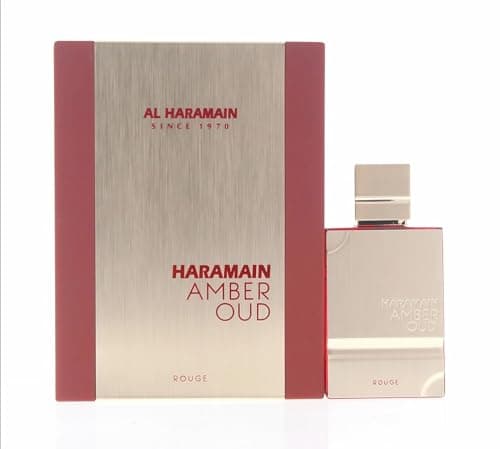
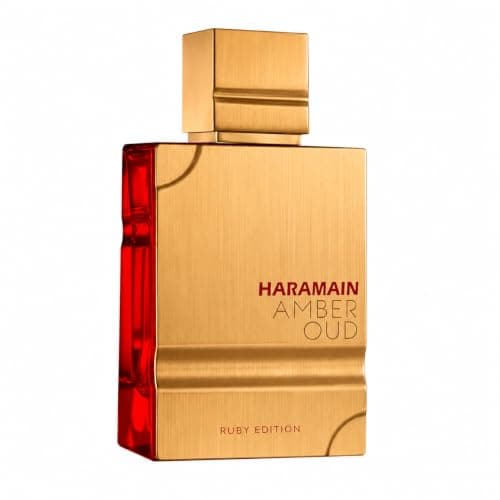
Same line, same target, one word apart
Al Haramain's Amber Oud collection has grown into a shelf of near-identical red-and-gold boxes, and two of them are separated by a single word: Amber Oud Rouge (2019) and Amber Oud Ruby Edition(2022). Both are eau de parfum. Both are aiming at the saffron-and-amberwood shape of Maison Francis Kurkdjian Baccarat Rouge 540. Both are still current — the house's own online store lists each of them in stock as of this writing, so this is not a discontinued-versus-replacement situation, whatever the forum threads say.
They are not, however, the same fragrance. Read the published note lists side by side and Ruby adds two materials Rouge does not have, and those two materials are exactly what people are reacting to when they say one smells "sharper" or "sweeter" than the other. If you have been going back and forth between the two tabs, this page is the comparison you were looking for — and if you landed here meaning the third bottle in the family, the Amber Oud Gold vs Ruby comparison covers that pairing instead, because Gold is a fruity-vanilla amber that has nothing to do with either of these.
What each one actually is
Amber Oud Rouge is the spare one. Its published pyramid is three lines long: saffron on top, jasmine in the heart, and ambergris, musk and white cedar extract underneath. Fragrantica files it as an amber floral, and retailer listings put it in a 2 oz / 60 ml and a 4 oz / 118 ml bottle. There is nothing in that note list that is not part of the accord it is chasing, which is the whole point of it.
Amber Oud Ruby Editionis the fuller one. Saffron again on top, but paired with bitter almond; Egyptian jasmine in the heart, but with cedarwood beside it; ambergris, woody notes and musk in the base. Fragrantica files it as an amber woody rather than an amber floral, and Al Haramain's own listing describes it as a woody floral. Our full Amber Oud Ruby Edition review takes it apart on its own terms.
So the difference on paper is two additions: bitter almond in the opening and cedarwood in the heart. That sounds minor. It is not. Bitter almond is a loud, marzipan-adjacent material that changes the first impression of anything it is in, and cedar dries out a floral heart in a way jasmine alone never does.
| | Amber Oud Rouge (2019) | Amber Oud Ruby Edition (2022) |
|---|
| Published top | Saffron | Saffron, bitter almond |
| Published heart | Jasmine | Egyptian jasmine, cedarwood |
| Published base | Ambergris, musk, white cedar extract | Ambergris, woody notes, musk |
| Classified as | Amber floral | Amber woody |
| Concentration | Eau de parfum, both |
| Reads as | Leaner, more literal BR540 | Sweeter, rounder, nuttier |
| Opening | Divisive — medicinal for some | Smoother from the first spray |
| Street price | Ruby is the cheaper of the two, usually by a wide margin — the live numbers are on the cards above |
How that difference plays out in wear
Rouge is the more accurate copy, and it is not close. Strip a BR540 clone back to saffron, jasmine and amber-woods and you get something that reads as the original to most noses, because that triangle isthe original's signature. Community data backs that up: Fragrantica's page for Rouge carries a 4.27 out of 5 average from 819 votes, with 497 members explicitly tagging it as reminding them of Baccarat Rouge 540 — the figures compiled in dupe.com's BR540 dupe report, where Rouge is the top community-validated pick of the whole field.
Rouge also has the worse first ten minutes, and this is the single most-repeated criticism of it. Owners describe the opening as medicinal, bandage-like or faintly rubbery before the saffron warms up — the same report turns up in the aggregated complaint counts and in individual Parfumo reviews. Some people never notice it. Some people cannot get past it. It is a real coin flip and you should know about it before you buy blind.
Ruby sands that entry down. Bitter almond gives the opening a sweet, nutty roundness that covers the sharp edge Rouge exposes, and cedar keeps the middle from going syrupy. The result is a scent you can like from the first spray rather than from minute twelve. The trade is honesty about what you are buying: it is a variation on the BR540 accord rather than the most faithful version of it, and owners who know Rouge well often describe Ruby as the tamer of the two.
On performance, we will not hand you hour counts for either, because the honest picture is messy. Both are strong eau de parfums by owner consensus and neither is a two-hour scent on clothing. But Rouge in particular draws contradictory reports — some owners call it a beast, others report recent bottles fading fast — and that inconsistency is the tax you pay at this tier. Our longevity and sillage guide explains why two people can wear the same bottle and report numbers three hours apart.
The name trap: there are more than two bottles here
A lot of people searching "rouge vs ruby" are not actually comparing these two. The Amber Oud family also includes the Gold Edition, a fruity melon-and-vanilla amber that smells nothing like either of these, plus Black, Tobacco and Carbon editions. And separately, there is Orientica Amber Rouge — a different label entirely, sold in a heavy gold-capped bottle, and frequently stocked right next to the Al Haramain range. It is the bottle most often crowned the best overall BR540 alternative, including in our own Baccarat Rouge 540 dupes ranking, and it is not Amber Oud Rouge.
If you are shopping from a phone with four tabs open, check three things on the listing before you pay: the brand name, the edition word (Rouge, Ruby, Gold), and the size. Those three fields are the only reliable way to tell these apart, because the packaging photography will not help you.
Price, size and what you are actually paying
Ruby is the cheaper bottle on the open market, typically by a wide enough margin that it is the obvious value pick of the pair. Rouge sits a tier above it — still firmly in budget-Arabian territory, still a small fraction of what the niche fragrance it echoes costs, but no longer an impulse buy. Both are listed at dramatically higher prices on Al Haramain's own store than at the retailers people actually use, which is worth knowing the next time you see an eye-catching "percent off" badge: the discount is measured against a number almost nobody pays.
Size matters more than usual here. Rouge is sold in both a 2 oz and a 4 oz, and the larger bottle improves the per-ml math considerably if you already know you like it. That is a real if: committing to 118 ml of a fragrance with a divisive opening is how half-full bottles end up on resale sites. If you have smelled neither, our guide to sampling cologne before buying covers the cheap ways to try both before you spend real money on either.
The honest cons, on both sides
Rouge's knocks: the medicinal-to-rubbery opening is the top complaint and it is frequent enough that you should treat it as likely rather than unlucky. Batch variation is widely reported, including recent bottles that owners say underperform older ones. Nose blindness is a recurring theme too — it goes quiet to the wearer long before it goes quiet to the room, which invites over-spraying. And it is the pricier of the two.
Ruby's knocks: the bitter almond that fixes the opening also moves it away from the accord you came for, so purists find it less convincing. It wears sweeter, which narrows where it works. Batch variation is a fact of life at this tier for Ruby too. And like its sibling, it is a cold-weather, evening-leaning fragrance rather than anything versatile.
Neither list is a reason to walk away. They are the reasons these bottles cost what they cost. What we will not tell you is that either one is indistinguishable from the niche fragrance it references, because neither is — the original's transparent, airy quality is the part nobody at this price has managed to copy.
Season, occasion and dose
Both belong to cold weather. Saffron, amber and musk get heavy and cloying in heat, and Ruby's almond sweetness makes that worse rather than better. Fall through winter, evenings rather than mornings, and social settings rather than shared offices — that is the honest envelope for both of them, and it is why neither appears in our work-safe ranking.
Dose discipline matters more with these than with a designer eau de toilette. Both are concentrated, both go quiet to your own nose while still projecting, and both are cheap enough to encourage generosity with the atomizer. One or two sprays is the dose; our spray-count guide covers how this scales with concentration. If you are new to this end of the market entirely, the best Arabian fragrances ranking puts both bottles in the context of the wider category, including several that are easier to wear than either.
The verdict
Buy Ruby.For most people asking this question, it is the better bottle to own: the same family accord, a first impression you do not have to wait out, and the lower price of the two. It is the one we feature as Al Haramain's BR540 interpretation everywhere else on this site, and nothing in the research changes that.
Buy Rouge if accuracy is the entire point. If your goal is the closest legitimate approximation of that saffron-amberwood signature and you are willing to trade a rough opening and some batch roulette for it, Rouge is the more faithful bottle and the community record says so clearly. Just go in knowing the first ten minutes are part of the deal.
And if neither of those trade-offs appeals, the answer is probably a third bottle rather than one of these two — our BR540 dupes ranking lays out the whole field, including the Orientica and Maison Alhambra options and what each one gives up. Our scores here come from compiled research: published note pyramids, concentration data, and aggregated owner and community reports, plus first-hand impressions only where they are genuine. They are judgments, not lab measurements, and our methodology page says exactly what that means.